Create a Web Page 101
Making Web Pages Intro
What is a Web Page?
Why Make a Web Page?
The History of HTML
Learn HTML or XHTML?
Basic HTML
Basic HTML Tutorials
Basic HTML Necessities
How to Make a Web Page
How to Edit a Web Page
The Basics of HTML Tags
Basic HTML Page Structure
HTML Attributes
HTML Font Codes
HTML Font Codes Intro
HTML Font Color Codes
HTML Font Size Codes
HTML Font Style Codes
HTML Bold/Italic Codes
Combining Font Codes
Formatting Text
Formatting Text Intro
Making Paragraphs
Miscellaneous Formatting
Headings & Subheadings
Creating Hyperlinks
Using Graphics
Using Graphics on the Web
Add Graphics to Your Pages
Graphics and Accessibility
How to Align Graphics
Page Color & Background
Graphics as Hyperlinks
Horizontal Rules
Creating Tables
HTML Tables Tutorials
HTML Table Fundamentals
Background & Border Color
Table Frames & Rules
Table Width and Alignment
Cells 1 -Space & Alignment
Cells 2 -Row Column Span
Cells 3 -Width & Height
Making Lists
HTML Frames
HTML Frames Tutorials
Using Frames for Layout
Advanced Frame Layouts
Putting Hyperlinks in Frames
Frame Border Width
Color, Margin and Control
Problems with Frames
SmartFrames: A Solution
SSI: An Alternative to Frames
Web Page Forms
Making Feedback Forms
A Simple Feedback Form
Installing NMS FormMail
Debugging Your Setup
My Web Host is Out to Lunch
User Input Components
Text Fields
Checkboxes & Radio Buttons
Dropdown Menus
Push Buttons
Layout and Presentation
Basic CSS
Basic CSS Tutorials
What is CSS?
Why You Should Use CSS
How to Use CSS
Inline Styles
Embedded Style Sheets
External Style Sheets
Class Selectors
ID Selectors
Combining Selectors
CSS Properties
CSS Properties Intro
Font Styles
Width, Height & Spacing
Borders
Backgrounds
Position
Float & Alignment
Hyperlinks
All About Web Hosting
Hosting Your Own Website
What is a Web Host?
Your Website's Home Page
Building a Website Offline
About Free Web Hosting
Best Free Web Hosting
Commercial Web Hosting
How to Get a Domain Name
Ecommerce Web Hosting
Web Hosting Terminology
Free Web Design Tools
Best Free Website Tools
Best Free Text Editors
Best Free Graphics Editors
Free Website Analysis Tools
Setting Up HTML Kit
HTML Kit Introduction
How to install HTML Kit
Screenshot Breakdown
Basic Configuration
Overall Appearance
Shortcuts and Startup
Editing Window
Customizing Toolbars
Using the Favorites Tab
Making a New Actions Bar
Odds and Ends
Free Templates
Free Website Templates
Two Column Fixed Width
Three Column Liquid Layout
Miscellaneous Templates
Dynamic Menu Effects
Two Column Experimental
Terms of Use
About These Templates
Website Templates Help
Getting Started
Template Zip File Download
How to Edit Your Template
What to Edit in the HTML
How to Add Your Logo
Making a Website
Web Design Tips
Web Design Basics
Tables vs. Tableless
Using Tables for Layout
Example Table Layouts
World's Crappiest Web Page
Twitter Backgrounds
Twitter Backgrounds Intro
Cool Twitter Backgrounds
Cool Twitter Backgrounds 2
Plain Twitter Backgrounds
Dark Twitter Backgrounds
Best Twitter Backgrounds
Cute Twitter Backgrounds
Music Twitter Backgrounds
Music Twitter Backgrounds 2
Twitter Backgrounds 101
TERMS OF USE
All About Web Browsers
What is a Web Browser?
Mozilla Firefox
Internet Explorer
Opera
How to Set Up Firefox
Top 5 Firefox Extensions
Contact
Basic HTML Web Page Structure
html element and always terminates with the end tag of the html element as follows:Example 1
<html>


...web page...


</html>
The
html element basically tells your computer that this is an HTML document. All other element tags are 'nested' within the start and end html tags. The web page is then further subdivided into two main sections which are the 'head' and the 'body'. The head section begins with the
<head> start tag and terminates with the </head> end tag. Immediately following this comes the <body> start tag and just before the html end tag comes the </body> end tag. There is only one set of
<html>...</html> tags, one set of <head>...</head> tags and one set of <body>...</body> tags. This basic HTML web page structure can be illustrated by the following example:<html>
<head>
</head>
<body>
</body>
</html>The head section or document head has little content and mostly contains HTML coded instructions on how to title, categorize and 'run' the web page. The body section or document body on the other hand contains almost all of the content that you will put on your web page and this content —usually text but can also be pictures and sounds— is formatted using more HTML code. All text that you place outside of any angle brackets will become 'visible text' and will be displayed by your web browser on your web page. By placing that text in between the start and end tags of certain HTML elements, you can instruct a web browser where and how to display that text.
Adding a Title to your Web Page
Okay let's build further on Example 2. (Click here to read a previous page in this tutorial if you are not familiar with how to create and edit an HTML document.)
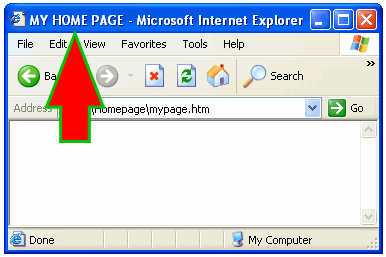
Web pages usually have a title that appears in the title bar that runs across the very top of the web page. This title is created using the
<title>...</title> tags which are themselves always nested within the <head>...</head> tags. All text appearing after the <title> start tag and before the </title> end tag will be displayed as your web page title. Hence the following HTML code will produce a web page entitled 'My Home Page':Example 3
<html>


<head>


<title> My Home Page </title>


</head>


<body>


</body>


</html>
Adding a Title to your Web Page
Adding Content to your Web Page
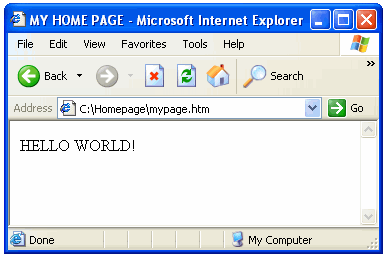
Now to add some content to your web page all you have to do is type some text in between the
<body>...</body> tags. So let's, for example, put the words 'HELLO WORLD!' on your web page. <html>
<head>
<title> My Home Page </title>
</head>
<body>
HELLO WORLD!
</body>
</html>This will produce a web page that looks like this:
Of course, you're probably going to want to do alot more than just create a web page with a title and some plain text on a blank white background. So let's conclude this set of tutorials with learning how to use HTML elements in conjunction with HTML attributes...
Best Free Stuff
for webmasters
for webmasters
Free Text Editors
Free Graphics Editors
Website Analysis Tools
Free Website Templates
See also:
If you need a .COM web address, you can get one quick and easy at...
| <~ BACK | TOP | NEXT ~> |